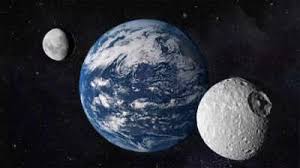
For more than 60 years, Earth has been stalked by a space rock without any of us realising. And we have no idea where it even came from.
Well, kind of. Astronomers have discovered that a tiny asteroid, named 2025 PN7, is accompanying our planet in a rare orbital ballet.
The asteroid is estimated to be as small as 62 feet, about as long as a bowling lane.
Most asteroids are ancient rocks made from the leftovers of our solar system’s formation, while others are chunks of the Moon flung into space by an impact on the lunar surface tens of thousands of years ago.
But because there are so few sightings of 2025 PN7, researchers wrote in a recently published article in the journal Research Notes of the American Astronomical Society that there are ‘no real hints about its origins’.
Does the Earth now have two moons?
No, the Earth does not have two moons, stressed Dr Alfredo Carpineti, a science writer for IFLScience.
Dr Carpineti, the author of the upcoming astronomy book, Invisible Rainbows, told Metro that this is because 2025 PN7 doesn’t orbit Earth like the Moon does.
Instead, it orbits the Sun at roughly the same distance as we do, a bit like a car driving in the lane next to you on the motorway.
Because the asteroid’s orbit is in lock step with Earth’s, this means 2025 PN7 is a ‘quasi moon’, rather than a moon, he said.
Wait, what is a quasi-moon?
A quasi-moon is an object ‘that appears to go around the Earth but is not gravitationally bound by it’, said Dr Carpineti.
These are different from ‘mini-moons’, which are objects that orbit our planet. But mini-moons tend to only be fleeting visitors, like 2024 PT5, which circled the blue marble for just two months before packing its bags.
By contrast, quasi-moons can be our cosmic companions for tens or even hundreds of years.
While scientists at the University of Hawaii spotted 2025 PN7 in August, they later realised by combing archival photos that the rock shuffled into its quasi-moon orbit in 1957.
According to observations, 2025 PN7 orbits the sun in an elliptical path that is inside Earth’s orbit part of the time and outside part of the time.
[Read More…]