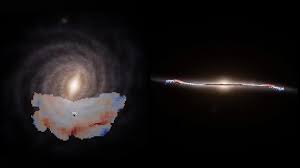
The Gaia space telescope has revealed that our Milky Way galaxy has a giant wave rippling outwards from its center, as illustrated in this figure. Here the positions of thousands of bright stars are shown, overlaid on Gaia’s maps of the Milky Way. Credit: ESA/Gaia/DPAC, S. Payne-Wardenaar, E. Poggio et al (2025)
Our Milky Way is constantly in motion: it spins, it tilts, and, as new observations reveal, it ripples. Data collected by the European Space Agency’s Gaia space telescope show that our galaxy is not only rotating and wobbling but also sending out a vast wave that travels outward from its center.
For about a century, astronomers have known that the Milky Way’s stars orbit its core, and Gaia has precisely tracked their speeds and trajectories. Since the 1950s, scientists have also recognized that the galactic disc is not flat but warped. Then in 2020, Gaia uncovered that this warped disc slowly oscillates over time, similar to the motion of a spinning top.
Now, researchers have identified an enormous wave that moves through the Milky Way, influencing stars tens of thousands of light-years from the Sun. The phenomenon is like a rock dropped into a pond, where the resulting ripples spread outward — only here, the “ripples” are made of stars, stretching across the galaxy’s outer regions.
The newly revealed wave is illustrated in the figure above. Thousands of bright stars, shown in red and blue, are overlaid on Gaia’s detailed map of the Milky Way.
In the image on the left, we see our galaxy from a top-down perspective. The right panel shows a side view, cutting vertically through the galactic plane. From this angle, the left portion of the galaxy curves upward while the right side bends downward (this is the warp of the disc). The red and blue regions mark the newly discovered wave: red areas indicate stars located above the warped plane, while blue areas show stars lying below it.
Although no spacecraft can venture beyond the galaxy, Gaia’s remarkably precise measurements — covering all three spatial dimensions (3D) and three components of motion (toward and away from us, and across the sky) — allow scientists to construct these top-down and edge-on views of the Milky Way.
These maps reveal that the wave extends over a vast section of the disc, affecting stars located about 30,000 to 65,000 light-years from the galactic center (the Milky Way itself measures about 100,000 light-years across).
“What makes this even more compelling is our ability, thanks to Gaia, to also measure the motions of stars within the galactic disc,” says Eloisa Poggio who is an astronomer at the Istituto Nazionale di Astrofisica (INAF) in Italy, and led the team of scientists that discovered the wave.
[Read More…]