Scientists crack a 50-year solar mystery with a scorching discovery
September 17, 2025 2025-09-17 13:47Scientists crack a 50-year solar mystery with a scorching discovery
Scientists crack a 50-year solar mystery with a scorching discovery
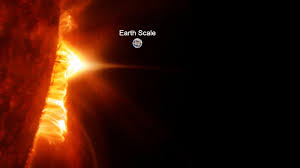
Solar flares are sudden and huge releases of energy in the Sun’s outer atmosphere that heat parts of it to greater than 10 million degrees. These dramatic events greatly increase the solar X-rays and radiation reaching Earth and are hazardous to spacecraft and astronauts, as well as affecting our planet’s upper atmosphere.
The research, published on Sept. 3 in Astrophysical Journal Letters, looked at evidence of how flares heat solar plasma to greater than 10 million degrees. This solar plasma is made up of ions and electrons. The new research argues that solar flare ions, positively charged particles that make up half of the plasma, can reach over 60 million degrees.
Looking at data from other research areas, the team, led by Dr Alexander Russell, Senior Lecturer in Solar Theory from the School of Mathematics and Statistics, realized that solar flares are very likely to heat the ions more strongly than the electrons.
Dr Russell, said: “We were excited by recent discoveries that a process called magnetic reconnection heats ions 6.5 times as much as electrons. This appears to be a universal law, and it has been confirmed in near-Earth space, the solar wind and computer simulations. However, nobody had previously connected work in those fields to solar flares.”
“Solar physics has historically assumed that ions and electrons must have the same temperature. However, redoing calculations with modern data, we found that ion and electron temperature differences can last for as long as tens of minutes in important parts of solar flares, opening the way to consider super-hot ions for the first time.”
“What’s more,” he added, is that the new ion temperature fits well with the width of flare spectral lines, potentially solving an astrophysics mystery that has stood for nearly half a century.”