
How space data centers for AI work
October 30, 2025 2025-10-30 15:40How space data centers for AI work
How space data centers for AI work
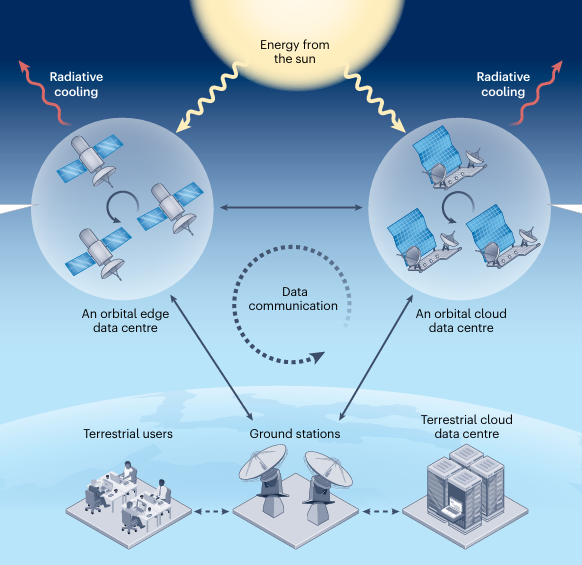
Space data centers could be a creative solution to AI’s “energy appetite.” Against the backdrop of Goldman Sachs’ forecast of a ~165% increase in data center electricity consumption by 2030, researchers at NTU Singapore have proposed moving computing into orbit: using virtually unlimited solar energy and free radiation cooling from space. Such systems are available in two formats: orbital edge centers for preliminary data processing directly on satellites, and distributed orbital systems with servers, broadband communications, and large solar panels. This can dramatically reduce the volume of unfiltered data transmitted to Earth and the load on ground networks.
How does it work? Simply put, the idea is like this: some of the “heavy” work for AI is moved into orbit. There’s almost unlimited solar energy there to power the servers, and space is like a giant fridge where it’s easy to get rid of heat without spending money on air conditioning. The satellites carry radiation-protected computers that immediately process raw data streams (from cameras, radars, telescopes), filter out unnecessary information, and send only compressed results to Earth via radio or laser.
Why is this useful? Calculations performed directly in orbit reduce the load on radio channels and allow telescopes, probes, and orbital radars to immediately filter out noise, transmitting only significant events to Earth — transients, gravitational wave indicators, or images with anomalies. This reduces the time from observation to discovery, increases the autonomy of long-distance missions (Mars, outer planets), and makes scientific campaigns cheaper, as hundreds of gigabytes of raw data no longer need to be sent to Earth. NTU estimates that orbital preprocessing can reduce the volume of data transmission by more than 100 times.